Saturday, August 13, 2022

August 8

There have been some major political events in the past week. On Monday. there was the first FBI search of a former President's home/hotel. It was on the anniversary of Nixon's resignation on August 8, 1974. I previously wrote about my memories of that day--All Politics is Personal (https://storiesoflivingwithghosts.blogspot.com/2016/07/all-politics-is-personal.html). 

On Friday, the Search Warrant was released. It mentioned suspicion of violation of the Espionage Act and failure to respond to a subpoena. Several commentators mentioned than Nixon's involvement in Watergate pales in comparison. The Washington Post has even reported that nuclear secrets may be involved (https://www.washingtonpost.com/national-security/2022/08/11/garland-trump-mar-a-lago/).

While further information is sure to come, the information so far is concerning. I hope that this information will, like with Watergate, result in the creation of further safeguards to reduce the likelihood of similar events in the future.

Saturday, March 26, 2022

Pray to die in the Flash

For children growing up during the Cold War, "duck and cover" was a regular drill in school. Recent events make many think back to the Cold War. For the major players, it was relatively peaceful, though proxy wars caused significant suffering for people in countries, like Korea and Vietnam, where they were fought. 

Yet, nuclear war did not seem likely through much of the Cold War. Certainly, there were tense moments, like the Cuban missile crisis. But, recent events have made it seem more likely than it has seemed for most of my life. The "Doomsday Clock" sits at 100 seconds to midnight (https://thebulletin.org/doomsday-clock/current-time/?utm_source=Google&utm_medium=Ads&utm_campaign=SearchAds&utm_content=DoomsdayClock_2022Statement&gclid=Cj0KCQjw0PWRBhDKARIsAPKHFGgBqwh-71w6xZBGmU5JOTxZwmdTK8gufrD4NBZyyyPJrnbTlmNHK2saAnh7EALw_wcB). The clock has been closer to midnight for the past few years due to risks of the spread of nuclear weapons.

Nuclear weapons are seriously being discussed as an option by a major nuclear power (https://www.euronews.com/next/2022/03/26/what-are-tactical-nuclear-weapons-and-could-russia-use-them-in-ukraine). Yet, there would be no way to limit a nuclear war. Radiation could spread over a large area with lethal complications to nearby countries, triggering a response and possibly leading to WWIII. Through our history of nuclear weapons, the future of the world has been dependent on rational leaders of nuclear countries, who understand that a nuclear war is not winnable. The risk is that some are discussing their use, and others are testing new weapons (https://www.nytimes.com/2022/03/24/world/asia/north-korea-missile-icbm.html?fbclid=IwAR2UeRLOr1QhebFH2eky9vEpGUhlr_jCF6TVwt7ETApex_29UiX4_yxj9ZY).

The current war in Ukraine exposes another risk, that of an attack on a nuclear power plant, which could also cause a nuclear disaster (https://thebulletin.org/2022/03/could-an-attack-on-ukrainian-nuclear-facilities-cause-a-disaster-greater-than-chernobyl-possibly-simulations-show/), whether that was intended or not. This could force millions of people to need to be evacuated due to the risk of radiation exposure. In the midst of an ongoing war, this evacuation would be difficult, as millions are fleeing violence due to conventional weapons. Yet, failure to evacuate after such an accident could expose many to the risk of death or radiation sickness or later malignancies. 

Clearly, "duck and cover" would do nothing to reduce the risk of radiation sickness or malignancy. There is no strategy to avoid the risks of nuclear war or damage to a nuclear power plant with release of radiation other than to avoid it. We must work to prevent what we cannot cure. Any of these events would be a global health catastrophe (https://www.psr.org/blog/global-medical-and-public-health-organizations-call-for-immediate-end-to-war-in-ukraine-and-critical-need-to-prevent-nuclear-escalation/).

If we are unable to stop this escalation, I fear for the future. I do not want to see suffering and death of billions of people all over the world. I do not want to see my family or myself among the suffering masses. Finally, I recall the advice from my parents, many years ago, to "pray to die in the flash."

Sunday, March 13, 2022

Appeasement and Fear

 As I watch news, I think back to history. In 1938, western powers consented to the annexation of the Sudetenland. In 1939, Poland was invaded by Germany on September 1. The Soviets invaded 17 days later. Poland fought valiantly yet could not succeed against 2 powerful adversaries. Poland was occupied and continued to resist, at great cost. Despite mutual defense agreements, Britain and France did not intervene, lest the war expand even more. But it did. Millions died, both in battle and being murdered in concentration camps and gulags, whether directly or because of overwork and starvation. 

After massing troops on the border of Ukraine a month ago, an invasion was begun a week ago. Already the Hague is investigating war crimes. The world has united and condemned the invasion (U.N. General Assembly in historic vote denounces Russia over Ukraine invasion | Reuters). NATO has become more united. The EU had a standing ovation when the President of Ukraine asked for a fast-tracked membership. 

The news has continued to mirror 1939 when civilians were killed in the fields, along roads seeking to escape the war. We can recall where this lead. Just as annexation of the Sudetenland in 1938 did not prevent a war, WWII did not stop with the division of Poland between Germany and the Soviet Union.

Thursday, July 30, 2020

History repeats

Fifty-one years ago I traveled to Europe for the first time. Part of the trip was with a student group. One of the places we visited was Prague, a beautiful city. But, many of the buildings bore scars from recent damage to the stones and brick. There were also a few tanks still to be seen.

Alexander Dubcek had presided over liberalization of Soviet era policies in Czechoslovakia. In August, 1968, Warsaw Pact troops invaded. Dubcek was taken to Moscow where he was forced to make concessions. He was eventually demoted in April, 1969, finally down to being a forestry inspector. (https://www.britannica.com/biography/Alexander-Dubcek)

Czechoslovakia became communist following WWII after elections in 1946 had significant representation by communist and leftist parties. By 1948, the communists had forced other coalition parties out of government. The Communist party, supported by the Soviet Union, then took control of the government, and remained in power until 1989. (https://www.history.com/this-day-in-history/communists-take-power-in-czechoslovakia)

The period of liberalization in 1968 was known as the Prague Spring (https://en.wikipedia.org/wiki/Prague_Spring). Students and intellectuals had been very active in pushing for the liberalization and also resisting the invasion, though there were other signs of resistance, such as changing direction signs in villages to confuse the invading troops and adulterating Pilsner beer, which is named after the Czech city of Pilsen.

I recall that the beer was still adulterated during my visit. I had heard that it was highly regarded, but it was greenish and tasted terrible when we were there. Another memory from that trip is impossible to forget. We were loading the bus at the border checkpoint. I was ordered to stand by a tall wall. Three soldiers who looked barely 18 trained their guns on me while an officer asked me questions in Czech. I could not understand and asked that he speak to me in a language I understood. I tried to calm myself while praying that I would not be sent to a gulag. I knew the stories I had heard about gulags and labor camps in the Soviet Union. I also sensed that if I flinched, it might be over. Finally, since the bus driver refused to leave without me, I was allowed to board the bus and we left. It was a case of mistaken identity. I have often wondered what happened to the woman for whom I was mistaken.

When the Warsaw Pact troops arrived 72 Czechs and Slovaks were killed and an additional 702 were injured (https://en.wikipedia.org/wiki/Prague_Spring). As I watch the news about the reaction to Black Lives Matter protests with federal agents in some cities, I recall the aftermath of the Prague Spring. I never expected anything in the US to remind me of what I saw there. But, I see history repeating.

Thursday, June 4, 2020

Remembering Tiananmen

Thirty one years ago today the protests against the communist government in China were put down.
Many of us remember the iconic photo of the Tank Man, who bravely stood in front of a line of tanks heading to Tiananmen Square While he may have escaped, thousands of others did not when the army opened fire on the protesters (https://news.yahoo.com/tiananmen-square-massacre-tank-man-111656080.html). Their bodies were unceremoniously removed by bulldozers for incineration (https://news.yahoo.com/tiananmen-square-massacre-tank-man-111656080.html).

I recall first hearing the news of the massacre in my car. I was going grocery shopping that morning. I stopped and sat stunned in my car as I listened to the entire news report. I had been hopeful that reform could happen in China as it had in many other communist countries. The first elections after the fall of communism in Poland also happened on June 4, 1989 with Solidarity winning a decisive victory (https://en.wikipedia.org/wiki/1989_Polish_legislative_election). The news of the Tiananmem massacre crushed my hope for reform.

Reporting of the crackdown was difficult as satellite transmissions for most networks were cut off (https://en.wikipedia.org/wiki/1989_Tiananmen_Square_protests). Reporters tried to continue reporting, using telephones and smuggling footage out of the country (https://en.wikipedia.org/wiki/1989_Tiananmen_Square_protests). World leaders, like George HW Bush and Margaret Thatcher condemned the crackdown (https://news.yahoo.com/tiananmen-square-massacre-tank-man-111656080.html).

One person, not yet a leader, praised the Chinese leaders for their "strength" in putting down the protests in a Playboy interview in 1990 (https://www.sbs.com.au/news/dateline/old-trump-interview-with-playboy-resurfaces-discusses-strength-of-china-s-response-in-tiananmen-square?fbclid=IwAR2QxhOaP97117jpwKllnJoc5SmdAazjxFnr4ncVBraDY92YUQoTDKNiaTo). He also commented that Gorbachev did not have "a firm enough hand." More recently, this same person, now a President, has wanted to deploy the US military to suppress Black Lives Matter protests (https://www.sbs.com.au/news/dateline/old-trump-interview-with-playboy-resurfaces-discusses-strength-of-china-s-response-in-tiananmen-square?fbclid=IwAR2QxhOaP97117jpwKllnJoc5SmdAazjxFnr4ncVBraDY92YUQoTDKNiaTo).

As I watch events unfolding now, I am again worried for the future. I pray for a future in which people can be free to express their opinions. 

Black Lives Matter

I am a fair skinned white woman. I have friends who are police officers. One friend even told me about killing someone in the line of duty. His partner was killed, and my friend was injured in a shootout with someone they had gone to arrest. My friend was off work for about a year due to his injuries. I don't recall my friend mentioning the race of the person whom he killed.

Yet, I have experienced fear of the police, too. The most recent was when a faulty alarm system called the police to my home for a suspected home invasion. The police had guns drawn when I answered the door. They walked through my house and asked to see my ID. I had to go to get it, and they followed me, guns drawn the whole time. Finally they left. I know that my age and skin color likely helped to save my life that day. But, I was scared by having a gun pointed at me by a police officer in my own house.

The worst such experience was in another country when I was not allowed to board a tour bus to cross from the border to leave the country. I was told to stand in front of a wall. Three young soldiers trained their weapons on me, while an officer asked questions in a language I did not understand. All I could think of was to try to calm myself. I told them I would answer questions in any of the 3 languages I knew at the time. I kept repeating this in each of the languages. I prayed they did not shoot me. I prayed that if they didn't let me go I would end up in a Czech prison rather than a Soviet gulag. I knew stories about gulags from family and friends who had escaped with the Anders (Polish) Army during WWII. Fortunately, the tour bus driver refused to leave without me, so they finally let me go. I had just turned 15.

I know the fear, but, fortunately, it is not a daily event for me. That is one of the benefits of white privilege. Sadly, many Americans experience this fear frequently. Driving while Black, Jogging while Black, Sleeping while Black, Playing while Black, Birdwatching while Black could all end in death. It's not possible to anticipate when such an event. But, even if such an event never happens to an individual or doesn't result in death, worry about the risk can lead to stress and the attendant health problems. And, these health problems may shorten lives. Black Americans have life expectancies that are 3 years shorter for women and 5 years shorter for men than white Americans (https://www.cdc.gov/nchs/data/nvsr/nvsr68/nvsr68_07-508.pdf). Black Americans also are suffering higher death rates from coronavirus than white Americans, in part due to the increased toll of stress related illnesses.

I understand the anger of those for whom it is a daily event. These killings need to stop. They never should have been a fact of life for so many. All people should be treated equally. We must, as a society, work to change attitudes. Martin Luther King dreamed of a place when a person is judged not by the color of their skin, but by the content of their character. I do, too.

Wednesday, February 12, 2020

Another Political Massacre

Years ago, I remember Nixon's Saturday Night Massacre. More recently, but still a while ago, I remember meeting the child of one of those fired that night. The daughter recalls her life being disrupted, from being happy in school, to suddenly moving across the country in ignominy. Her parents were able to rebuild, and her father did again serve in government. However, the daughter felt that the experience had influenced her politics and choice of career. Less than a year a year later, Nixon resigned. (My experiences at the time of Nixon's resignation are discussed in another post--All Politics is Personal.)

Recently, the United States has gone through another Impeachment, this time with a brief trial with preordained acquittal. And, shortly after the Senate returned the vote, the last few witnesses were forced out of their positions in apparent retribution for their testimony. The brother of LTC Alexander Vindman, LTC Yevgeny Vindman was also forced to leave the White House, though both continue to serve in other capacities (https://www.npr.org/2020/02/07/803904417/lt-col-alexander-vindman-escorted-out-of-the-white-house-his-lawyer-says).

Then four Justice Department lawyers resigned rather than agree to reduced sentencing recommendations for sentencing of Roger Stone (https://www.washingtonpost.com/national-security/justice-dept-to-reduce-sentencing-recommendation-for-trump-associate-roger-stone-official-says-after-president-calls-it-unfair/2020/02/11/ad81fd36-4cf0-11ea-bf44-f5043eb3918a_story.html).

This time, it seems that the "lesson" learned was not what Senator Susan Collins says she hoped had been learned because of the Impeachment. It is useful to compare Clinton's contriteness on acquittal to Trump's celebration (https://www.msnbc.com/rachel-maddow-show/following-impeachment-acquittal-trump-celebrates-no-regrets-n1132146). Perhaps other Senators thought there would be a moderation of behavior, like Senator Collins. Instead, it seems they have granted Carte Blanche to a more imperious President.

I don't know what the future holds, but my reading of the past concerns me.

Sunday, February 2, 2020

Becoming a Satellite

As I listen to the impeachment hearings, the "fictional narrative" described by Dr. Fiona Hill as a Russian disinformation campaign makes me wonder if we are living through a period like the expansion of the Soviet sphere of influence after WWII.
We have a political party that seems to regard loyalty to party as more important than loyalty to country. This party is much like that described by George Orwell in 1984, "The party told you to reject the evidence of your eyes and ears. It was their final, most essential command."
I wonder and worry what this new frontier will hold if the president can do whatever he wants, and his followers support him. 

Monday, November 18, 2019

Career service

Fiona Hill was the Russian director at the National Security Council. Excepts of the transcript of her testimony were reported by Rachel Maddow on November 8, 2019. For her willingness to testify before Congress, she has been subject to threats, as she reported Ambassador Marie Yovanovitch was, who was even threatened during her public testimony (https://www.theatlantic.com/ideas/archive/2019/11/why-trump-attacked-marie-yovanovitch/602134/?utm_source=facebook&utm_medium=social&utm_content=edit-promo&utm_term=2019-11-16T14%3A40%3A15&utm_campaign=the-atlantic&fbclid=IwAR1xQ_sdZxgYdqtOj5kcEKEJs5G-j7EGW05SKbx_mU6ZNJ41ZbP_EDGhi68). Similarly, Lt. Col. Alexander Vindman, the Ukraine expert at the NSC has been publicly attacked for his Ukrainian Jewish background. All of these professionals are career public servants. Civil servants, like the military, are usually underpaid for their skills and expertise (https://www.nytimes.com/2019/11/14/opinion/taylor-kent-impeachment-hearings.html?fbclid=IwAR1boEXJKEvDfDI43yGEzI4OyQcyyFd2WYY_mYzU_vNnl8Q4_Rg3Q30DjFk). They work for the good of society and their country.

While I don't recall meeting Marie Yovanovitch in Kyrgyzstan, I may well have. She was ambassador there from November, 2004 to February, 2008 (https://en.wikipedia.org/wiki/Marie_Yovanovitch). I made two trips to Kyrgyzstan in 2006 and 2007. I recall a fund-raising reception for Kyrgyz orphans sponsored jointly by the American and German embassies. Since I was there while in the process of two of these orphans, it made sense to attend the reception and donate to the cause. I recall that all the embassy staff I met both at the reception and the embassy there were very professional. They made the adoption process flow smoothly. This professionalism has been true at all the embassies I have visited over the years.

I can vouch for this, not only from the articles, but also growing up the child of two civil servants. Many other relatives also served, either in civil service or the military. They tend not to be partisan, and cannot express publicly their political opinions. These individuals often can make more outside of government, as was certainly the case for my parents. Yet, they chose public service, and impressed that ideal on me (though I have mostly worked in county hospitals). 

The individuals who are being called to testify are demonstrating their love of country and loyalty despite the threats they must face for doing so. They have sworn loyalty to the Constitution and to defend the nation "against all enemies, foreign and domestic." They are continuing to do so.

Wednesday, November 6, 2019

Watergate Redux

A few years ago, I wrote the blog, "All Politics is Personal," about Watergate and Nixon's resignation on August 8, 1974. As I listen to the news, I am reminded about the Watergate investigation.

The information being presented begins with a phone call with a quid pro quo offer to a foreign country, namely Ukraine. There is a suggestion that there was an earlier deal with Ukraine in 2017 (https://www.msnbc.com/rachel-maddow/watch/trump-may-have-worked-a-previous-ukraine-quid-pro-quo-wapo-72641605878?cid=sm_npd_ms_fb_ma&fbclid=IwAR0wpqbJeea3-H0yFJ75kXh0Ij4AXYTACqFxJOMwprp_EbAy5IRsOh2lDyc). The deafening silence about the earlier deal may have led some to think that this was "business as usual." No wonder these individuals are now puzzled by the attention this time.

Another concerning development is the defense of blaming the investigators, again seeking help from abroad (https://www.independent.co.uk/news/world/americas/us-politics/trump-impeachment-inquiry-latest-russia-mueller-ukraine-zelensky-a9181641.html). Another defense is the switching of targets, "whataboutism." This was associated with Soviet/Russian propaganda (https://en.wikipedia.org/wiki/Whataboutism). Yet, while I am no lawyer, I doubt that the defense of someone else committing a crime would be adequate. This seems more a technique of distraction, assuming the public will not notice what the magician is actually doing.

Meanwhile, Time describes "abuse of power" in the behavior of the President (https://time.com/5714064/trump-abuse-of-power-women/?utm_source=facebook&utm_medium=social&utm_campaign=editorial&utm_term=ideas_&linkId=76320528&fbclid=IwAR1S9iJJ7Qe3jI8PwaLb2W03pQ03Gr9Y2i9B0n-eOdDIidRzcgHVOfn5hgg). They use the example of the pattern of abuse beginning in relationships with women, but then extending to others.

As I watch this unfolding, I am reminded of Nixon and Watergate. Nixon was a lawyer, and so had some knowledge of, and presumably respect for the Constitution. Perhaps that is why he chose to resign once it was clear that he would otherwise be impeached. This time, I am not sure how things will unfold. I hope that we are able to hold the country together.

Sunday, October 13, 2019

“Who knows only his own generation remains always a child”


The Warsaw Uprising ended October 2, 1944, after starting on August 1 that year. Despite being undersupplied, Poles fought to end the Nazi occupation which had existed for 5 years. The Red Army was approaching and the Poles wanted to evict the Germans from their capital (https://www.britannica.com/event/Warsaw-Uprising).
The Germans began evacuating the city, expecting to lose it to the Poles and Soviets. The Poles expected support from the Soviets, who were in the alliance against the Nazis. But, the Soviets stopped across the Vistula River and waited (https://www.britannica.com/event/Warsaw-Uprising). The Polish troops in the Soviet army wanted to help their compatriots, but Stalin refused, even recalling the general in charge of the Polish troops under Soviet command, Zygmunt Berling. As the Germans realized that the Soviets would not aid the Poles, they decided to squash the Uprising.
Overall, the Germans killed 16,000 members of the Polish resistance and 150-200,000 civilians during the Uprising. Ten thousand civilians were killed on August 5 alone.
The Poles had the largest underground in occupied Europe, plus troops fighting under British and Soviet command, many of whom had been imprisoned by the Soviets at the start of the war under the terms of the Molotov-Ribbentrop Pact. In all, Poles were the fourth largest “nation” fighting against the Axis in Europe. I have nation in quotes here since Poland ceased to exist after the invasions by Germany and the Soviet Union in 1939.
This October, we are seeing another “nation” being slaughtered. This time, again, they are being sacrificed by an ally. They have fought with this ally for many years, and soldiers on came to trust each other. Turkey invaded northern Syria where many Kurds live, an outcome expected by most after the US withdrawal (https://www.washingtonpost.com/politics/unswayed-by-top-advisers-trump-doubles-down-on-decision-to-withdraw-troops/2019/10/13/3305b884-edfc-11e9-b2da-606ba1ef30e3_story.html).
American military officers and special forces troops report being saddened by the decision to abandon Kurdish allies, with whom they had fought for years against ISIS. In another example of the brutality of this invasion, Kurds are being executed by Turkish troops after being abandoned by the US, while Turkish troops film themselves (https://www.washingtonpost.com/world/middle_east/turkish-led-forces-film-themselves-executing-a-kurdish-captive-in-syria/2019/10/13/22e11198-ed9c-11e9-89eb-ec56cd414732_story.html). This behavior is reminiscent of the executions filmed by ISIS, whom the American-Kurdish alliance had previously fought. The Turks seem to be trying to push Americans further from the border, so there will be fewer witnesses to their actions against the Kurds (https://www.washingtonpost.com/national-security/2019/10/12/us-forces-say-turkey-was-deliberately-bracketing-american-forces-with-artillery-fire-syria/?fbclid=IwAR28p0rpfRbz0ZYnuC0XhHvdLhV6EFr3dfkCZgt9VsXDpJy7vCIoqn6QQMQ).
As an American, I am ashamed of this abandonment of the Kurds, just as my parents were ashamed of the abandonment of the Poles during and after WWII. Such abandonment can turn people against us, as others have in the past. Actions such as this abandonment will result in blow-back, maybe from the Kurds, more likely from the rebuilding of ISIS from those who escaped from the Kurds. T he idea of the “Ugly American” is not without cause.
The Norlin Library at the University of Colorado is named for Dr. George Norlin (https://www.colorado.edu/libraries/about/history/george-norlin). He gave speeches rebuffing the Scopes “monkey” trial and refused to fire Catholic and Jewish faculty on the request of the governor of Colorado. After spending time in Berlin in 1933, he wrote and spoke about the dangers of Nazism and anti-Semitism. An inscription for over the west entrance of the library reads “Who knows only his own generation remains always a child.”

Thursday, August 29, 2019

1619

1619 was a momentous year in the Jamestown colony. It marks both the first labor strike in English North America and the introduction of African slaves to the colony.

Polish craftsmen first came to Jamestown in 1608, brought by John Smith who had earlier become aware of their skills. In 1619, the colony held its first election, but denied suffrage to the Poles because they were not Englishmen, even though they were hired workers (Pula). The Poles refused to work and called a strike unless they were given the right to vote, and the decision was reversed, and the Polish workers were considered free and enfranchised (Pula). The date of the strike is uncertain, but the representative assembly convened on June 30, 1619 (Crews), so the election was likely in the Spring.

On August 20, 1619, a Dutch ship, the White Lion, arrived in Jamestown carrying "20 and odd" Africans (NYT). While it is not clear what the initial status of the Africans was, unlike European indentured servants, logs did not list an end date for their indenture (Encyclopedia.com).  By 1640, an African was ordered to "serve his said master...for the time of his natural life" (Encyclopedia.com) for running away, while 2 white servants who ran away with him had their indenture extended by one year (NYT). Race based slavery then became the norm across the American colonies by the mid-17th century (Wood).

While the connection between the strike and the start of race based slavery is unclear, it seems likely that the first labor strike might have caused landowners to look for options so they wouldn't be at risk of future work stoppages from indentured servants or even hired workers such as the Poles of Jamestown. The court decision of 1640 served to separate workers' status on the basis of race, hence making it unlikely that Black and white workers would work together to improve their status after that point, even though the escape involved workers of both races who might have seen their fates as similar before that point.

We must learn from the past. Workers have more in common with each other than with the wealthy, or as we now call them the 1%. The wealthy want to control the rest of us. Yet, working together, we can be powerful, and improve our lives.


References

Reset text size
NEW YORK TIMES MAGAZINE, "THE 1619 PROJECT." NEW YORK TIMES MAGAZINE, 2019. https://timesevents.nytimes.com/1619NYC

PULA, JAMES S. "FACT VS. FICTION: WHAT DO WE REALLY KNOW ABOUT THE POLISH PRESENCE IN EARLY JAMESTOWN?" The Polish Review 53, no. 4 (2008): 477-93. http://www.jstor.org/stable/25779776.

WOOD, PETER H. "THE BIRTH OF RACE BASED SLAVERY: BY THE 17TH CENTURY, AMERICA'S SLAVE ECONOMY HAD ELIMINATED THE OBSTACLE OF MORALITY." SLATE May 19, 2015. http://www.slate.com/articles/life/the_history_of_american_slavery/2015/05/why_america_adopted_race_based_slavery.html

Sunday, August 27, 2017

No Man is an Island

As another hurricane has hit Texas causing flooding and loss of life, I think it is important to look at how we, as a society, treat the less fortunate.  Texas declined the medicaid expansion of the Affordable Care Act, and so its citizens are chronically at risk. This morning I read a review by Danielle Ofri, MD, of the book, "No Apparent Distress," by Rachel Pearson, MD (https://www.nytimes.com/2017/08/25/books/review/rachel-pearson-no-apparent-distress.html?_r=1).  In it, Dr. Pearson's stories about those who fall through the cracks are described.

I have spent most of my career working in "safety net" hospitals. Yet, even here, there are requirements for copayment. In the case of scheduled surgeries, copayment may be required in advance. Sometimes, this may be more than $2000. Clearly, a fee this high might cause a patient to question if they should wait. And many do. Sometimes, the disease will progress, and be more costly to treat. But, this usually affects primarily the patient and their family. And, often the taxpayer.

Medical diseases like diabetes and hypertension can also be far more costly if treatment is delayed. A common medication for hypertension costs less than $10 per month, yet a hypertensive brain hemorrhage may require a week in ICU at over $2000/day, followed by weeks of rehabilitation, and perhaps never returning to the pre-hemorrhage level of functioning. And, at the time of the hemorrhage, care is mandated by EMTALA (the Emergency Medical Treatment and Active Labor Act). So, again, we must all bear the increased costs of delaying care. While this is an unfunded mandate, doctors and hospitals must either recoup the costs or decide to go out of business, so they don't need to provide the care. But, closing Emergency Rooms affects anyone who needs one. So, this may affect all of us.

Infectious diseases pose even more of a threat to all of society. When I was a medical student, many of the homeless had been exposed to a non-toxin producing variant of diphtheria. Thus, if the typical toxin producing variant developed in the area, they and those who had received the DPT vaccine (https://en.wikipedia.org/wiki/DPT_vaccine) would be best protected. Since a booster is recommended every 10 years, many healthy adults would be unprotected simply because they didn't keep up with revaccination. But, this is just theoretical.

About 20 year ago, I took care of a toddler who had tuberculous meningitis. He was neurologically devastated by it. His infection was traced to a daycare provider with a chronic cough. This worker couldn't afford to take time off to spend at least half a day at a public clinic to have the cough checked out, so continued to work with children, who are the most likely to be devastated by tuberculosis. And, yet, how many of us pay for childcare? And, do we always check on the workers? Since these workers often are low paid, many are immigrants. 

Cysticercosis is another disease that may spread from the less fortunate. It is a pork tapeworm often encountered in third world countries. But, humans can have both gut and tissue, such as brain or eye, involvement. The gut involvement is caused by eating infected meat. The tissue involvement is caused by eating infected feces. Yet, pay for both agricultural workers and food service workers is low, so many are immigrants. In the field, workers may have no toilet facilities or bathroom breaks. Food service workers may also not have optimal hygiene. Health education is scant for such occupations with low pay and frequent turnover. Testing and treatment is rare. So, such workers may not only have tissue involvement, but, also gut involvement. So, all of us are at risk. In 1992, several Orthodox Jews were reported to have cysticercosis (http://www.nejm.org/doi/full/10.1056/NEJM199209033271004#t=article). 

We do not exist as islands. We interact with other people. We may eat meals prepared by others. Our children may be cared for by others. The most affluent may be able to have their domestic help tested and treated for various infectious diseases. Less affluent people likely can't insist on this. But, most of us, at least occasionally, eat food grown and prepared by others. So, if the least fortunate can't afford care, the more fortunate may also suffer. It is not only ethical for a society to help the less fortunate; it is also beneficial for the more fortunate.

Thursday, August 10, 2017

Fire and fury

This week marked 72 years since the first uses of nuclear weapons at the end of WWII. Yet, once again, it seems that their use may be being considered again. I recently saw a video (<iframe src="https://www.facebook.com/plugins/video.php?href=https%3A%2F%2Fwww.facebook.com%2Fnamelesstv%2Fvideos%2F1759173391042313%2F&show_text=0&width=476" width="476" height="476" style="border:none;overflow:hidden" scrolling="no" frameborder="0" allowTransparency="true" allowFullScreen="true"></iframe>). The Department of Homeland Security posts the same advice in text format (https://www.ready.gov/nuclear-blast). These both suggest there is a reasonable hope to survive.

Recently, rhetoric has intensified between North Korea and the US (http://www.cnn.com/2017/08/10/politics/trump-north-korea/index.html, https://www.cnbc.com/2017/08/10/us-only-option-on-n-korea-nuclear-threat-wesley-clark-commentary.html).

North Korea has tested small nuclear weapons already and has threatened to strike Guam (https://www.washingtonpost.com/world/national-security/north-korea-now-making-missile-ready-nuclear-weapons-us-analysts-say/2017/08/08/e14b882a-7b6b-11e7-9d08-b79f191668ed_story.html?utm_term=.fb122dcb1f37), and may soon be able to reach the western US mainland, and maybe further into the US. Certainly, even if they have 60 nuclear weapons soon, a number which is miniscule compared to the US or Russia, who each have over 100 times more, and more sophisticated weapons, this could result in millions dead, initially on the Korean peninsula, and with the possibility of extending further, even while still remaining local, to other nuclear powers.

The information on surviving a nuclear blast suggests listening to radio and TV to hear public service announcements on where to go. Yet, it is likely that TV and radio would be functioning, at least initially, due to the electromagnetic pulse which accompanies a nuclear blast (http://www.businessinsider.com/nukes-electromagnetic-pulse-electronics-2017-5). This would also affect the systems used by emergency services to direct any rescue efforts and the rescue vehicles themselves, as they, like most other modern vehicles are heavily dependent on their onboard computers. So most of the survivors would be left to care for themselves. Similarly, even if one could walk to a hospital, the hospital would be similarly affected. And, they would likely be overwhelmed by the numbers of casualties. And, then, fallout would continue as radiation falls on neighboring areas, determined by winds. During a war, there may be multiple blasts, each with the same consequences. How fast the emergency services could be brought back to service is a question.

Survivors may have neurologic dysfunction, nausea, vomiting and diarrhea which may lead to dehydration and nutritional problems, bleeding, damage to the immune system which may lead to life-threatening infections. Those who survive the early period are at risk for various cancers, especially leukemia and thyroid. Other cancers including breast, esophagus, colon and lung are also increased. Survivors of Hiroshima and Nagasaki still are suffering and dying from radiation related illness (https://www.icrc.org/eng/assets/files/2013/4132-1-nuclear-weapons-human-health-2013.pdf).

The dust thrown up into the atmosphere would have yet another effect--a nuclear winter. A regional nuclear war could still devastate the environment and lead to worldwide suffering (https://www.sciencedaily.com/releases/2006/12/061211090729.htm, http://climate.envsci.rutgers.edu/pdf/acp-7-1973-2007.pdf). This research was based on simulations involving only 50 Hiroshima sized weapons (compared to North Korea's estimated 30-60 weapons, each on the order of twice the size of the weapon used at Hiroshima). This is estimated to be worse than the cooling produced by the eruption of Tambora in Indonesia in 1815, which caused the year without a summer in 1816 when people starved in Europe, China and even the United States.

The mass starvation would cause social disruption, as it did in 1815-1816, from the drought and severe el Nino which caused the Chumash Indians to abandon their settlements on islands off the coast of California (http://californiamissionsfoundation.org/articles/agriculturedroughtandchumashcongregation/), to riots in Europe and Asia, to unseating 70% of representatives in the 1816 election in the United States, to migrations from village to city with a subsequent pandemic beginning in Bengal (http://boris.unibe.ch/81880/7/tambora_e_web.pdf). Later, there was migration from Europe to the Americas and Russia, and westward in North America (http://boris.unibe.ch/81880/7/tambora_e_web.pdf). Some of my ancestors left Germany during this time period. They left because they hoped for a better life.

The nuclear winter after even a small nuclear war would likely lead to similar or larger scale societal disruptions, as people flee both war and famine. So, survivors of a nuclear war would have all these problems to contend with, and might die of the sequelae of the conflict. It is likely that their lives would be very different than they had before.

I remember that, during the Cold War, when we had "duck and cover" drills at school, my parents told me to pray to die in the flash, to be vaporized leaving only a shadow on the sidewalk. They said it would be far better than surviving. In a nuclear war, there are no winners. Everyone is a loser.


Thursday, November 10, 2016

Kristallnacht

Seventy eight years ago, the evening of November 9 was the beginning of the large scale arrest and imprisonment of Jews in Germany and Austria. Called Kristallnacht because of the large amount of broken glass from the windows of Jewish owned businesses. It was justified as a reaction to the murder of a German official, in Paris, by a 17 year old Polish Jew, distraught over the deportation of his family from Germany. Nazi officials claimed that the Jews were to blame for the riots, so 30,000 Jewish men were arrested, and the Jewish community fined for the damages. (https://www.ushmm.org/research/research-in-collections/search-the-collections/bibliography/kristallnacht) 

This was 5 years after the first concentration camps were founded, in 1933. Initially, many of the prisoners were political opponents of the Nazi regime, as Hitler sought to consolidate his power. (https://www.ushmm.org/wlc/en/article.php?ModuleId=10005263)  


The disabled were seen as having "lives not worth living," a burden to the state, and so were killed. Families were not told the truth about how their family member had died. Many of these patients, as well as prisoners, were dissected by German anatomists and pathologists. (http://www.slate.com/articles/life/history/2013/11/nazi_anatomy_history_the_origins_of_conservatives_anti_abortion_claims_that.html)


Homosexuals were seen as deviants and so were imprisoned in concentration camps, starting in 1933. They were treated poorly by guards and other prisoners, and so had a 60% death rate. (https://en.wikipedia.org/wiki/Persecution_of_homosexuals_in_Nazi_Germany_and_the_Holocaust)

Later, during the war, other groups--Poles, Roma, Soviet prisoners of war--became victims of the Nazi regime.

Lutheran Pastor Martin Niemoller, who was imprisoned in 1937, wrote,
"First they came for the Socialists, and I did not speak out—Because I was not a Socialist.
Then they came for the Trade Unionists, and I did not speak out—Because I was not a Trade Unionist.
Then they came for the Jews, and I did not speak out—Because I was not a Jew.
Then they came for me—and there was no one left to speak for me."
(https://en.wikipedia.org/wiki/First_they_came_...)

On this anniversary of Kristallnacht, we must again affirm, "Never Again." Never again should any people be persecuted or killed because of their religion, or race, or ethnicity, or sexual orientation. Because as Niemoller says, we have the duty to stand up for each other. 


Monday, August 29, 2016

Information Age

We live in the age of an information economy. Trading in information is now seen as a way to make a living. Information clearly has economic benefit in the corporate world, so one can get a "jump" on the competition. In a similar way, governments have long been involved in seeking to know what an adversary is doing, or planning. Over recent years, there have been a spate of movies about the codebreaking efforts of WWII. 

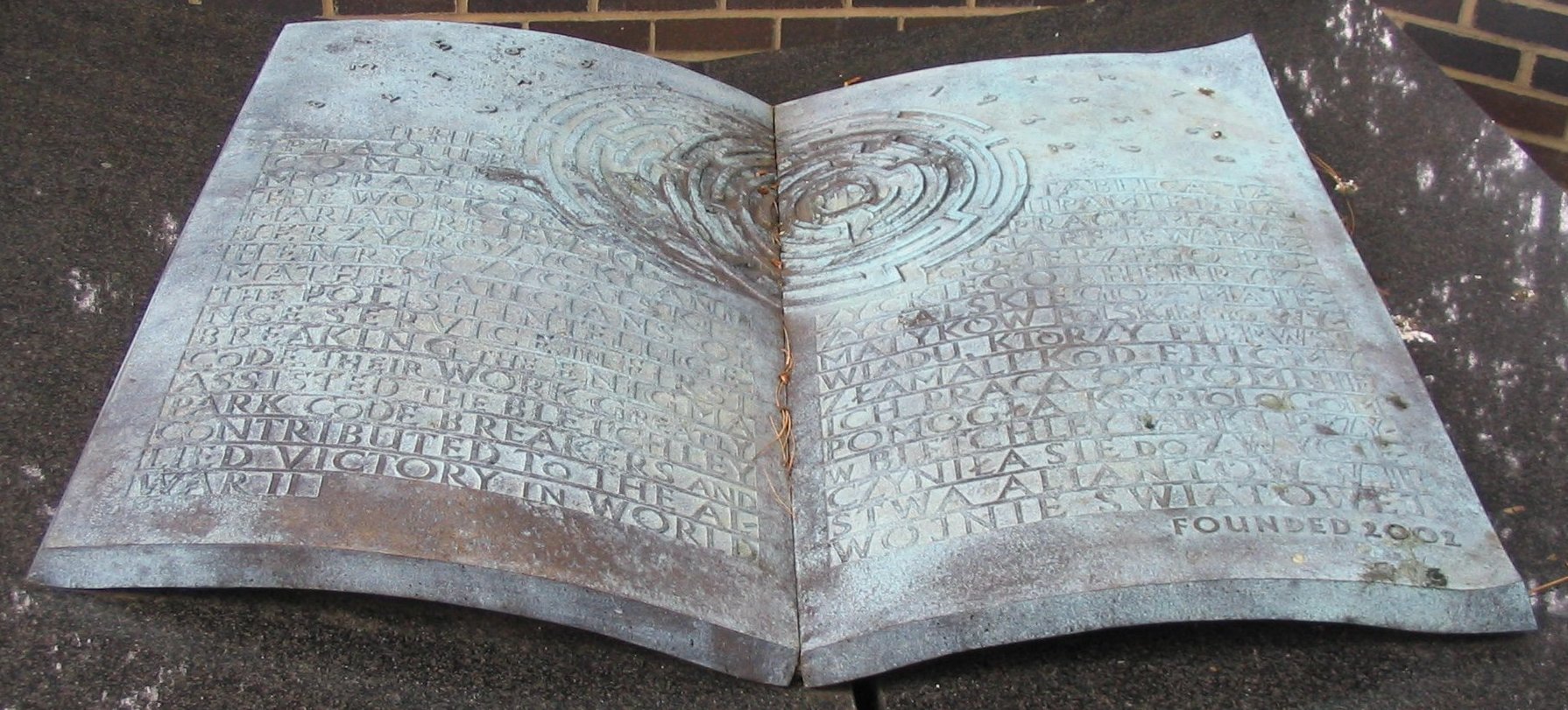
Initially, the German Enigma code was broken by Polish mathematicians, Marian RejewskiJerzy Różycki and Henryk Zygalski, working for Polish military intelligence. Just ahead of the invasion of Poland, bomba (mechanical codebreaking machine) were provided to the French and the British. This was the basis of the work during the war at Bletchley Park. Unfortunately, although the Poles had been first to break the code, they were deemed to be to high a security risk to work at Bletchley Park. 

Later, the same concept was applied and the British then built bombes for use at Bletchley Park. They were different in design than the Polish bomba, but, used the mathematical concepts developed by the Poles. The Polish contribution has been more recently acknowledged, as demonstrated by the plaque below.


CC BY-SA 2.0, https://commons.wikimedia.org/w/index.php?curid=460477

Discovering the secrets of others, through codebreaking or other means, has long been a major function of intelligence services.  Another approach has been the planting of false information. This has been used, not only to influence governments, but also to influence electorates.

In the 1980s, there was a Soviet disinformation campaign aimed at blaming the US government for developing the HIV/AIDS virus, and suggesting that it was to be a genocide of Black people (https://en.wikipedia.org/wiki/Operation_INFEKTION).  It had some effect, leading many to question what the origin of the virus was and led to further distrust of the American health care system.

More recently, there have been efforts at influencing public opinion regarding international events, such as the shooting down of a Malaysian jetliner over Ukraine. There have also been efforts at influencing election outcomes, presumably to get a result more favorable to the country which is interfering, whether in a referendum, such as Brexit, or election of political figures. (http://www.nytimes.com/2016/08/29/world/europe/russia-sweden-disinformation.html) This involves not only releasing factual information, but, making lies appear to be the truth. 

As someone who feels it is my duty to be an informed voter, it is increasingly difficult. There is no easy way to distinguish what is true and what is not. And, for many voters, there seems to be a trust in beliefs rather than facts. But, is this really unreasonable, when one can't trust "facts." So, it just seems easier to "trust" someone who seems "trustworthy" rather than attempt the seemingly Herculean task or sorting out what is true and what is not. To me, it seems most reasonable just to ask, "Who benefits?" and, "Do they have friends who would be able to construct a plausible reality?" To me, this is the greater concern, as authoritarian government is frightening to me, whether from the left or the right.


Tuesday, August 9, 2016

All Politics is Personal

August 9 is the anniversary of two important events. The first was the second use of nuclear weapons. Nagasaki. Coming three days after the first use.

My family was involved in the Manhattan Project. Many scientists and engineers were. But, after use of the bomb, many were plagued with a sense of responsibility. I discussed this more in my posts about President Obama's visit to Hiroshima. 

The second anniversary is that of the resignation of a President. Watergate. Adding "gate" to various other words has since come to suggest scandal. But, let's look back. The first election I voted in was 1972. The year of Watergate.

The Watergate scandal began when the DNC headquarters was broken into on June 17, 1972 (https://en.wikipedia.org/wiki/Watergate_scandal). It was in an office complex named Watergate, hence the name of the scandal. Investigation of the perpetrators lead to the Committee for the Reelection of the President, the aptly named CREEP. The ensuing scandal led to the resignation of the President Richard Nixon late on August 8, 1974, as the Watergate investigation led to Nixon's close aides. Gerald Ford then became President.But, first, Nixon tried to block the investigation by asking that the Special Investigator be fired. The Attorney General and a Deputy Attorney General both resigned, rather than comply, in what was called the Saturday Night Massacre on October 20, 1973. The Solicitor General then fired the Special Investigator at Nixon's bidding. Yet, Nixon could not stop the investigation.

I did not know of the resignation until August 9.  At the time, I was studying in Poland. A popular joke there, at the time, was that of an American, a Frenchman, and a Russian drinking together. The Frenchman commented that the best evening of his life was the evening spent with Brigitte Bardot (a popular French actress of the time). The American then said that the best evening of his life was an evening spent with the President. At this, all the Americans started laughing. And the Poles told us we hadn't heard the punchline. They then told us that the Russian then said that the best evening of his life was when two men came to his door and asked, "Are you Ivan Ivanovich?" He told his friends that he had said, "No." And then, he said, they left. That was the punchline. And, this joke, like so many others, expressed the truth that the Poles knew.

Years later, I interviewed a young woman, who was growing up in Washington at the time of Watergate. It was very interesting to hear the story told from the perspective of someone who had witnessed some of the events as a child. And, how those events impacted her and influenced her politics and choice of career.

The differences in reaction to the joke exposes the difference between the Americans who were, at the time, embarrassed by the Nixon and the events that led to his resignation. The Poles, on the other hand, had experienced the nighttime visits, and the visitors who didn't leave, but rather escorted the occupant out. My grandfather's second wife was given 15 minutes to pack for her family. Only two of them survived their two years in Siberia. None ever returned to their home in the Kresy, but rather had to wander for a while before finally making a home in the United States.

Tip O'Neill said, "All politics is local." But, I would suggest that it is personal. Each of us begins with the attitudes shared by our families. They have been shaped by their experiences. And, then, our personal experiences modify our political beliefs further.


Monday, July 11, 2016

Black Lives Matter, Blue Lives Matter

With the recent news of the shootings in Louisiana, Minnesota and Texas, I think about gun violence. I need to disclose that I am a middle aged white female. Yet gun violence and the fear of it have been part of my life.

At 15, I visited Prague. I went with a student group. We spent most of our summer in Germany, yet crossed to the East twice, once in Berlin, and then a few days in Prague. A beautiful city with so much history. Yet with fresh evidence of the suppression of the Prague Spring. Some of the leaders were still loose. And, the hard line authorities wanted to capture and punish them all.

As we were leaving Czechoslovakia, I was pulled off the bus, then queued up again, to have the same happen two more times. Then the officer began to question me. In Czech. I knew no Slavic languages except the bits of Polish I heard when we visited my grandparents. I asked him to repeat his questions in one of the languages that I knew. Yet this questioning was done with three young men with guns pointed at me. I dared not flinch, for fear that one of the soldiers might shoot. Meanwhile, I prayed that if they arrested me, for what I didn't know, they wouldn't send me to Soviet Union. I had heard bits of my grandmother's experience there working in a Siberian labor camp for the crime of being Polish. I knew I was too soft. Finally, I was allowed to board the bus, and leave the country. Then, the driver, who had understood the exchange told me that I looked like one of the student leaders. I never heard what happened to my twin. I hope she is well.

While in residency, I came to know my neighbor, who was a police officer. At first he was on medical leave. He had killed a man. His partner had also been killed in the shootout and my friend and neighbor injured.

My next experiences came when I worked in an inner city hospital. Gangs were active. There, I cared for hundreds of victims of all ages, from infancy up. But, usually, they respected those who cared for them. A colleague had his shoes stolen at gunpoint, but wasn't injured, because, "Doc, we might need you someday." A few times we were threatened that if a certain patient died, we would, too. And, once, we had a SWAT team in the hospital. We had to walk past them and their bullet proof shields to care for our patients, and worried that we might be caught in the crossfire.

Another threat was after I had been speaking out about gun violence after I cared for a young boy who had been shot on the freeway. He was one of about 20 shooting victims my hospital received on a typical Friday or Saturday in the mid-90s due to gang activity. This child was deemed different. He was middle class, from the suburbs, just driving home from a Dodger game with his cousins. So the press was interested. I spoke out, testified on the costs of gun violence to committees of city and state government. Thus, my photo was in the paper. And, a copy of my photo was sent to me with a target drawn over my face. Scary, but I knew that my activities were having an effect.

During this time, I also learned from colleagues the issues of "driving while Black," "running while Black," etc. It was something that had not been part of my experience until then. Instead, I had been told, even by Black and Hispanic colleagues, not to drive through certain neighborhoods.

Later, I had an alarm that triggered a "home invasion" alarm. I was home alone, by then middle aged, working on my computer, when the police came, with guns drawn, wanted proof that I was who I was. They looked through my home, following me, but finally left after I got my ID, showing this house as my address.

I realize that people are violent. But, guns increase the lethality of that impulse to violence. I don't have a solution, given the millions of guns in the hands of the American populace. I have worked in an area where gang violence was rampant. I have seen far too many lives destroyed by violence. I have worked to save and rebuild some of those lives.

I can understand that police may be afraid, but, I have seen reasonable control by well trained officers when we had the terrorist shooting in San Bernardino, not adding to the toll at the Inland Regional Center. I can understand that the people are afraid, especially Black men, but am impressed by the overall peaceful nature of the recent protests. I hope and pray that we can come together to end the violence. So that I don't have to try to patch up any more shattered victims.

Sunday, June 19, 2016

Juneteenth

Today is Juneteenth, the commemoration of the day the slaves in Texas were freed (http://www.juneteenth.com/history.htm; https://en.wikipedia.org/wiki/Juneteenth). Even though the Emancipation Proclamation freed the slaves in the Union on January 1, 1863, slaves in the Confederacy continued to be enslaved. After the surrender at Appomattox Court House on April 9, 1865 (https://www.nps.gov/apco/index.htm), news spread slowly through the Confederacy. Union soldiers led by General Gordon Granger arrived in Galveston on June 19, 1865, and brought the news. There was shock and jubilation. Some slaves left their plantations to find family in other states, or even if they had no where to go. June 19, or Juneteenth has become a time of celebration in the African American community. It is also a time of prayer, and focusing on education and self-improvement. Unfortunately, it is little known among whites in the US, though some suggest it is a second Independence Day (http://www.huffingtonpost.com/entry/juneteenth-photos_us_57640f77e4b0853f8bf08d36).

Unfortunately, June 19, 1865, did not end slavery. It continues to the present day. Walk Free estimates that 45.8 million people continue to be enslaved (https://www.walkfree.org/modern-slavery-facts/). Despite being illegal, slavery exists in nearly every country on earth. This year, attention has been directed to the slaves used in fishing, especially in international waters. One center of this is Thailand (http://www.theguardian.com/global-development/2016/feb/25/slavery-trafficking-thai-fishing-industry-environmental-justice-foundation).

Forced labor may also continue with governmental support, as is the case of cotton picking in Uzbekistan and Turkmenistan (http://www.antislavery.org/english/campaigns/cottoncrimes/forced_labour_in_uzbekistan_background.aspx). Brick making and garment making in India also often employ the use of slave labor (http://www.antislavery.org/english/slavery_today/what_is_modern_slavery.aspx).

Over half of slaves are women and children. Nearly 1 in 3 victims are children, often trafficked by someone they knew (https://www.walkfree.org/modern-slavery-facts/). Natural disasters, such as the earthquake in Nepal, lead to the trafficking of more children. Closer to home, only last year did Los Angeles County stop arresting children for prostitution, and begin treating them like victims (http://www.latimes.com/local/lanow/la-me-ln-sheriff-children-sex-trafficking-20151021-story.html).

So, on this Juneteeth, let us not only remember the past, as all Americans should, but work toward the elimination of slavery throughout the world today.


Wednesday, June 8, 2016

After the visit

On May 27th, President Barack Obama visited the Hiroshima Peace Memorial in Japan, the first time a US President has visited Hiroshima. He spoke of the horrors of war – of nuclear weapons in particular – as he stood by the evidence of the destruction caused by the relatively small weapons (by today's standards) used against Hiroshima and Nagasaki. Back in April of 2009, in Prague, President Obama said, "As the only nuclear power to have used a nuclear weapon, the United States has a moral responsibility to act. We cannot succeed in this endeavor alone, but we can lead it, we can start it. So today, I state clearly and with conviction America's commitment to seek the peace and security of a world without nuclear weapons."

During President Obama’s visit, I recalled my own visit to Hiroshima nearly 40 years ago. I was travelling with my parents, who had been involved, along with two uncles, in the Manhattan Project. Despite receiving honors, my father rarely spoke about his involvement in the project that would produce the first nuclear weapons during World War II. My mother often told of the moment of realization of the weapon they were working on, and the horror of it, tempered only at the time by the sense of necessity due to the war.

As we walked around the city and visited the museum, my parents hardly spoke. Both were quite somber throughout the day. It was clear to me that they felt a sense of responsibility. That visit had quite an effect on me as well, even though I was not born until years after the bombing. In 2006, I joined the board of the Los Angeles chapter of Physicians for Social Responsibility (PSR-LA), an organization dedicated to the prevention of nuclear war.

There are over 15,000 nuclear weapons in the world today; 94% of these are in the US and Russia. Currently, the US plans to spend $348 billion over the next 10 years and a trillion dollars over the next 30 years in order to “modernize” our nuclear weapons systems. Russia has also been updating its arsenal, and has renounced the "no first use" of nuclear weapons. We are into a new arms race.

We have avoided nuclear Armageddon for 70 years; yet, there have been at least five events since 1979 when either Moscow or Washington prepared to launch a nuclear war under the mistaken belief that it was already under attack by the other side.

With today's expansive weapons and arsenals, more people could be killed in hours than were killed during WWII. Even a limited war involving only 100 Hiroshima-sized bombs, less than 1% of the world's nuclear arsenals, could have devastating effects on the climate, could disrupt agriculture around the globe, causing a global famine that could kill 2 billion people, and triggering further wars for control of resources. If most of the weapons in the world's arsenals were used, a global ecological collapse – a nuclear winter – would result.

Recognizing the grave humanitarian consequences of nuclear war, the International Physicians for the Prevention of Nuclear War (IPPNW), the World Medical Association (WMA), the World Federation of Public Health Associations (WFPHA), and the International Council of Nurses (ICN), together representing 15 million health professionals, have called for a treaty to ban nuclear weapons worldwide. One hundred twenty-seven countries without nuclear weapons, supported by the International Committee of the Red Cross (ICRC) and civil society, have signed onto the "Humanitarian Pledge" legally prohibiting nuclear weapons.

During his visit to Hiroshima last month, President Obama said, “We may not be able to eliminate man’s capacity to do evil, so nations and the alliances that we form must possess the means to defend ourselves. But among those nations like my own that hold nuclear stockpiles, we must have the courage to escape the logic of fear and pursue a world without them.”

As President Obama said, “Those who died, they are like us. Ordinary people understand this, I think. They do not want more war. They would rather that the wonders of science be focused on improving life and not eliminating it. When the choices made by nations, when the choices made by leaders, reflect this simple wisdom, then the lesson of Hiroshima is done.” He spoke of the hibakusha (atomic bomb survivors), and acknowledged their experience and contributions. He spoke of their efforts to turn their experiences into messages of peace.

The world is a dangerous place. Nuclear weapons do not make us safe. Instead, we are more at risk. It is an existential risk for our species, and for all life on the planet. As President Obama said, “The world was forever changed here, but today the children of this city will go through their day in peace. What a precious thing that is. It is worth protecting, and then extending to every child. That is a future we can choose, a future in which Hiroshima and Nagasaki are known not as the dawn of atomic warfare but as the start of our own moral awakening.”

The United States cannot eliminate nuclear weapons alone. But, we can lead. It is our moral duty as the only nation to have ever used a nuclear weapon as an act of war. I know that is what my parents would want, and why they felt the need to take me to visit Hiroshima - so I could see the unparalleled destruction caused by these weapons, and understand that they must never be used again.