Sunday, October 13, 2019

“Who knows only his own generation remains always a child”


The Warsaw Uprising ended October 2, 1944, after starting on August 1 that year. Despite being undersupplied, Poles fought to end the Nazi occupation which had existed for 5 years. The Red Army was approaching and the Poles wanted to evict the Germans from their capital (https://www.britannica.com/event/Warsaw-Uprising).
The Germans began evacuating the city, expecting to lose it to the Poles and Soviets. The Poles expected support from the Soviets, who were in the alliance against the Nazis. But, the Soviets stopped across the Vistula River and waited (https://www.britannica.com/event/Warsaw-Uprising). The Polish troops in the Soviet army wanted to help their compatriots, but Stalin refused, even recalling the general in charge of the Polish troops under Soviet command, Zygmunt Berling. As the Germans realized that the Soviets would not aid the Poles, they decided to squash the Uprising.
Overall, the Germans killed 16,000 members of the Polish resistance and 150-200,000 civilians during the Uprising. Ten thousand civilians were killed on August 5 alone.
The Poles had the largest underground in occupied Europe, plus troops fighting under British and Soviet command, many of whom had been imprisoned by the Soviets at the start of the war under the terms of the Molotov-Ribbentrop Pact. In all, Poles were the fourth largest “nation” fighting against the Axis in Europe. I have nation in quotes here since Poland ceased to exist after the invasions by Germany and the Soviet Union in 1939.
This October, we are seeing another “nation” being slaughtered. This time, again, they are being sacrificed by an ally. They have fought with this ally for many years, and soldiers on came to trust each other. Turkey invaded northern Syria where many Kurds live, an outcome expected by most after the US withdrawal (https://www.washingtonpost.com/politics/unswayed-by-top-advisers-trump-doubles-down-on-decision-to-withdraw-troops/2019/10/13/3305b884-edfc-11e9-b2da-606ba1ef30e3_story.html).
American military officers and special forces troops report being saddened by the decision to abandon Kurdish allies, with whom they had fought for years against ISIS. In another example of the brutality of this invasion, Kurds are being executed by Turkish troops after being abandoned by the US, while Turkish troops film themselves (https://www.washingtonpost.com/world/middle_east/turkish-led-forces-film-themselves-executing-a-kurdish-captive-in-syria/2019/10/13/22e11198-ed9c-11e9-89eb-ec56cd414732_story.html). This behavior is reminiscent of the executions filmed by ISIS, whom the American-Kurdish alliance had previously fought. The Turks seem to be trying to push Americans further from the border, so there will be fewer witnesses to their actions against the Kurds (https://www.washingtonpost.com/national-security/2019/10/12/us-forces-say-turkey-was-deliberately-bracketing-american-forces-with-artillery-fire-syria/?fbclid=IwAR28p0rpfRbz0ZYnuC0XhHvdLhV6EFr3dfkCZgt9VsXDpJy7vCIoqn6QQMQ).
As an American, I am ashamed of this abandonment of the Kurds, just as my parents were ashamed of the abandonment of the Poles during and after WWII. Such abandonment can turn people against us, as others have in the past. Actions such as this abandonment will result in blow-back, maybe from the Kurds, more likely from the rebuilding of ISIS from those who escaped from the Kurds. T he idea of the “Ugly American” is not without cause.
The Norlin Library at the University of Colorado is named for Dr. George Norlin (https://www.colorado.edu/libraries/about/history/george-norlin). He gave speeches rebuffing the Scopes “monkey” trial and refused to fire Catholic and Jewish faculty on the request of the governor of Colorado. After spending time in Berlin in 1933, he wrote and spoke about the dangers of Nazism and anti-Semitism. An inscription for over the west entrance of the library reads “Who knows only his own generation remains always a child.”

Thursday, August 29, 2019

1619

1619 was a momentous year in the Jamestown colony. It marks both the first labor strike in English North America and the introduction of African slaves to the colony.

Polish craftsmen first came to Jamestown in 1608, brought by John Smith who had earlier become aware of their skills. In 1619, the colony held its first election, but denied suffrage to the Poles because they were not Englishmen, even though they were hired workers (Pula). The Poles refused to work and called a strike unless they were given the right to vote, and the decision was reversed, and the Polish workers were considered free and enfranchised (Pula). The date of the strike is uncertain, but the representative assembly convened on June 30, 1619 (Crews), so the election was likely in the Spring.

On August 20, 1619, a Dutch ship, the White Lion, arrived in Jamestown carrying "20 and odd" Africans (NYT). While it is not clear what the initial status of the Africans was, unlike European indentured servants, logs did not list an end date for their indenture (Encyclopedia.com).  By 1640, an African was ordered to "serve his said master...for the time of his natural life" (Encyclopedia.com) for running away, while 2 white servants who ran away with him had their indenture extended by one year (NYT). Race based slavery then became the norm across the American colonies by the mid-17th century (Wood).

While the connection between the strike and the start of race based slavery is unclear, it seems likely that the first labor strike might have caused landowners to look for options so they wouldn't be at risk of future work stoppages from indentured servants or even hired workers such as the Poles of Jamestown. The court decision of 1640 served to separate workers' status on the basis of race, hence making it unlikely that Black and white workers would work together to improve their status after that point, even though the escape involved workers of both races who might have seen their fates as similar before that point.

We must learn from the past. Workers have more in common with each other than with the wealthy, or as we now call them the 1%. The wealthy want to control the rest of us. Yet, working together, we can be powerful, and improve our lives.


References

Reset text size
NEW YORK TIMES MAGAZINE, "THE 1619 PROJECT." NEW YORK TIMES MAGAZINE, 2019. https://timesevents.nytimes.com/1619NYC

PULA, JAMES S. "FACT VS. FICTION: WHAT DO WE REALLY KNOW ABOUT THE POLISH PRESENCE IN EARLY JAMESTOWN?" The Polish Review 53, no. 4 (2008): 477-93. http://www.jstor.org/stable/25779776.

WOOD, PETER H. "THE BIRTH OF RACE BASED SLAVERY: BY THE 17TH CENTURY, AMERICA'S SLAVE ECONOMY HAD ELIMINATED THE OBSTACLE OF MORALITY." SLATE May 19, 2015. http://www.slate.com/articles/life/the_history_of_american_slavery/2015/05/why_america_adopted_race_based_slavery.html

Sunday, August 27, 2017

No Man is an Island

As another hurricane has hit Texas causing flooding and loss of life, I think it is important to look at how we, as a society, treat the less fortunate.  Texas declined the medicaid expansion of the Affordable Care Act, and so its citizens are chronically at risk. This morning I read a review by Danielle Ofri, MD, of the book, "No Apparent Distress," by Rachel Pearson, MD (https://www.nytimes.com/2017/08/25/books/review/rachel-pearson-no-apparent-distress.html?_r=1).  In it, Dr. Pearson's stories about those who fall through the cracks are described.

I have spent most of my career working in "safety net" hospitals. Yet, even here, there are requirements for copayment. In the case of scheduled surgeries, copayment may be required in advance. Sometimes, this may be more than $2000. Clearly, a fee this high might cause a patient to question if they should wait. And many do. Sometimes, the disease will progress, and be more costly to treat. But, this usually affects primarily the patient and their family. And, often the taxpayer.

Medical diseases like diabetes and hypertension can also be far more costly if treatment is delayed. A common medication for hypertension costs less than $10 per month, yet a hypertensive brain hemorrhage may require a week in ICU at over $2000/day, followed by weeks of rehabilitation, and perhaps never returning to the pre-hemorrhage level of functioning. And, at the time of the hemorrhage, care is mandated by EMTALA (the Emergency Medical Treatment and Active Labor Act). So, again, we must all bear the increased costs of delaying care. While this is an unfunded mandate, doctors and hospitals must either recoup the costs or decide to go out of business, so they don't need to provide the care. But, closing Emergency Rooms affects anyone who needs one. So, this may affect all of us.

Infectious diseases pose even more of a threat to all of society. When I was a medical student, many of the homeless had been exposed to a non-toxin producing variant of diphtheria. Thus, if the typical toxin producing variant developed in the area, they and those who had received the DPT vaccine (https://en.wikipedia.org/wiki/DPT_vaccine) would be best protected. Since a booster is recommended every 10 years, many healthy adults would be unprotected simply because they didn't keep up with revaccination. But, this is just theoretical.

About 20 year ago, I took care of a toddler who had tuberculous meningitis. He was neurologically devastated by it. His infection was traced to a daycare provider with a chronic cough. This worker couldn't afford to take time off to spend at least half a day at a public clinic to have the cough checked out, so continued to work with children, who are the most likely to be devastated by tuberculosis. And, yet, how many of us pay for childcare? And, do we always check on the workers? Since these workers often are low paid, many are immigrants. 

Cysticercosis is another disease that may spread from the less fortunate. It is a pork tapeworm often encountered in third world countries. But, humans can have both gut and tissue, such as brain or eye, involvement. The gut involvement is caused by eating infected meat. The tissue involvement is caused by eating infected feces. Yet, pay for both agricultural workers and food service workers is low, so many are immigrants. In the field, workers may have no toilet facilities or bathroom breaks. Food service workers may also not have optimal hygiene. Health education is scant for such occupations with low pay and frequent turnover. Testing and treatment is rare. So, such workers may not only have tissue involvement, but, also gut involvement. So, all of us are at risk. In 1992, several Orthodox Jews were reported to have cysticercosis (http://www.nejm.org/doi/full/10.1056/NEJM199209033271004#t=article). 

We do not exist as islands. We interact with other people. We may eat meals prepared by others. Our children may be cared for by others. The most affluent may be able to have their domestic help tested and treated for various infectious diseases. Less affluent people likely can't insist on this. But, most of us, at least occasionally, eat food grown and prepared by others. So, if the least fortunate can't afford care, the more fortunate may also suffer. It is not only ethical for a society to help the less fortunate; it is also beneficial for the more fortunate.

Thursday, August 10, 2017

Fire and fury

This week marked 72 years since the first uses of nuclear weapons at the end of WWII. Yet, once again, it seems that their use may be being considered again. I recently saw a video (<iframe src="https://www.facebook.com/plugins/video.php?href=https%3A%2F%2Fwww.facebook.com%2Fnamelesstv%2Fvideos%2F1759173391042313%2F&show_text=0&width=476" width="476" height="476" style="border:none;overflow:hidden" scrolling="no" frameborder="0" allowTransparency="true" allowFullScreen="true"></iframe>). The Department of Homeland Security posts the same advice in text format (https://www.ready.gov/nuclear-blast). These both suggest there is a reasonable hope to survive.

Recently, rhetoric has intensified between North Korea and the US (http://www.cnn.com/2017/08/10/politics/trump-north-korea/index.html, https://www.cnbc.com/2017/08/10/us-only-option-on-n-korea-nuclear-threat-wesley-clark-commentary.html).

North Korea has tested small nuclear weapons already and has threatened to strike Guam (https://www.washingtonpost.com/world/national-security/north-korea-now-making-missile-ready-nuclear-weapons-us-analysts-say/2017/08/08/e14b882a-7b6b-11e7-9d08-b79f191668ed_story.html?utm_term=.fb122dcb1f37), and may soon be able to reach the western US mainland, and maybe further into the US. Certainly, even if they have 60 nuclear weapons soon, a number which is miniscule compared to the US or Russia, who each have over 100 times more, and more sophisticated weapons, this could result in millions dead, initially on the Korean peninsula, and with the possibility of extending further, even while still remaining local, to other nuclear powers.

The information on surviving a nuclear blast suggests listening to radio and TV to hear public service announcements on where to go. Yet, it is likely that TV and radio would be functioning, at least initially, due to the electromagnetic pulse which accompanies a nuclear blast (http://www.businessinsider.com/nukes-electromagnetic-pulse-electronics-2017-5). This would also affect the systems used by emergency services to direct any rescue efforts and the rescue vehicles themselves, as they, like most other modern vehicles are heavily dependent on their onboard computers. So most of the survivors would be left to care for themselves. Similarly, even if one could walk to a hospital, the hospital would be similarly affected. And, they would likely be overwhelmed by the numbers of casualties. And, then, fallout would continue as radiation falls on neighboring areas, determined by winds. During a war, there may be multiple blasts, each with the same consequences. How fast the emergency services could be brought back to service is a question.

Survivors may have neurologic dysfunction, nausea, vomiting and diarrhea which may lead to dehydration and nutritional problems, bleeding, damage to the immune system which may lead to life-threatening infections. Those who survive the early period are at risk for various cancers, especially leukemia and thyroid. Other cancers including breast, esophagus, colon and lung are also increased. Survivors of Hiroshima and Nagasaki still are suffering and dying from radiation related illness (https://www.icrc.org/eng/assets/files/2013/4132-1-nuclear-weapons-human-health-2013.pdf).

The dust thrown up into the atmosphere would have yet another effect--a nuclear winter. A regional nuclear war could still devastate the environment and lead to worldwide suffering (https://www.sciencedaily.com/releases/2006/12/061211090729.htm, http://climate.envsci.rutgers.edu/pdf/acp-7-1973-2007.pdf). This research was based on simulations involving only 50 Hiroshima sized weapons (compared to North Korea's estimated 30-60 weapons, each on the order of twice the size of the weapon used at Hiroshima). This is estimated to be worse than the cooling produced by the eruption of Tambora in Indonesia in 1815, which caused the year without a summer in 1816 when people starved in Europe, China and even the United States.

The mass starvation would cause social disruption, as it did in 1815-1816, from the drought and severe el Nino which caused the Chumash Indians to abandon their settlements on islands off the coast of California (http://californiamissionsfoundation.org/articles/agriculturedroughtandchumashcongregation/), to riots in Europe and Asia, to unseating 70% of representatives in the 1816 election in the United States, to migrations from village to city with a subsequent pandemic beginning in Bengal (http://boris.unibe.ch/81880/7/tambora_e_web.pdf). Later, there was migration from Europe to the Americas and Russia, and westward in North America (http://boris.unibe.ch/81880/7/tambora_e_web.pdf). Some of my ancestors left Germany during this time period. They left because they hoped for a better life.

The nuclear winter after even a small nuclear war would likely lead to similar or larger scale societal disruptions, as people flee both war and famine. So, survivors of a nuclear war would have all these problems to contend with, and might die of the sequelae of the conflict. It is likely that their lives would be very different than they had before.

I remember that, during the Cold War, when we had "duck and cover" drills at school, my parents told me to pray to die in the flash, to be vaporized leaving only a shadow on the sidewalk. They said it would be far better than surviving. In a nuclear war, there are no winners. Everyone is a loser.


Thursday, November 10, 2016

Kristallnacht

Seventy eight years ago, the evening of November 9 was the beginning of the large scale arrest and imprisonment of Jews in Germany and Austria. Called Kristallnacht because of the large amount of broken glass from the windows of Jewish owned businesses. It was justified as a reaction to the murder of a German official, in Paris, by a 17 year old Polish Jew, distraught over the deportation of his family from Germany. Nazi officials claimed that the Jews were to blame for the riots, so 30,000 Jewish men were arrested, and the Jewish community fined for the damages. (https://www.ushmm.org/research/research-in-collections/search-the-collections/bibliography/kristallnacht) 

This was 5 years after the first concentration camps were founded, in 1933. Initially, many of the prisoners were political opponents of the Nazi regime, as Hitler sought to consolidate his power. (https://www.ushmm.org/wlc/en/article.php?ModuleId=10005263)  


The disabled were seen as having "lives not worth living," a burden to the state, and so were killed. Families were not told the truth about how their family member had died. Many of these patients, as well as prisoners, were dissected by German anatomists and pathologists. (http://www.slate.com/articles/life/history/2013/11/nazi_anatomy_history_the_origins_of_conservatives_anti_abortion_claims_that.html)


Homosexuals were seen as deviants and so were imprisoned in concentration camps, starting in 1933. They were treated poorly by guards and other prisoners, and so had a 60% death rate. (https://en.wikipedia.org/wiki/Persecution_of_homosexuals_in_Nazi_Germany_and_the_Holocaust)

Later, during the war, other groups--Poles, Roma, Soviet prisoners of war--became victims of the Nazi regime.

Lutheran Pastor Martin Niemoller, who was imprisoned in 1937, wrote,
"First they came for the Socialists, and I did not speak out—Because I was not a Socialist.
Then they came for the Trade Unionists, and I did not speak out—Because I was not a Trade Unionist.
Then they came for the Jews, and I did not speak out—Because I was not a Jew.
Then they came for me—and there was no one left to speak for me."
(https://en.wikipedia.org/wiki/First_they_came_...)

On this anniversary of Kristallnacht, we must again affirm, "Never Again." Never again should any people be persecuted or killed because of their religion, or race, or ethnicity, or sexual orientation. Because as Niemoller says, we have the duty to stand up for each other. 


Monday, August 29, 2016

Information Age

We live in the age of an information economy. Trading in information is now seen as a way to make a living. Information clearly has economic benefit in the corporate world, so one can get a "jump" on the competition. In a similar way, governments have long been involved in seeking to know what an adversary is doing, or planning. Over recent years, there have been a spate of movies about the codebreaking efforts of WWII. 

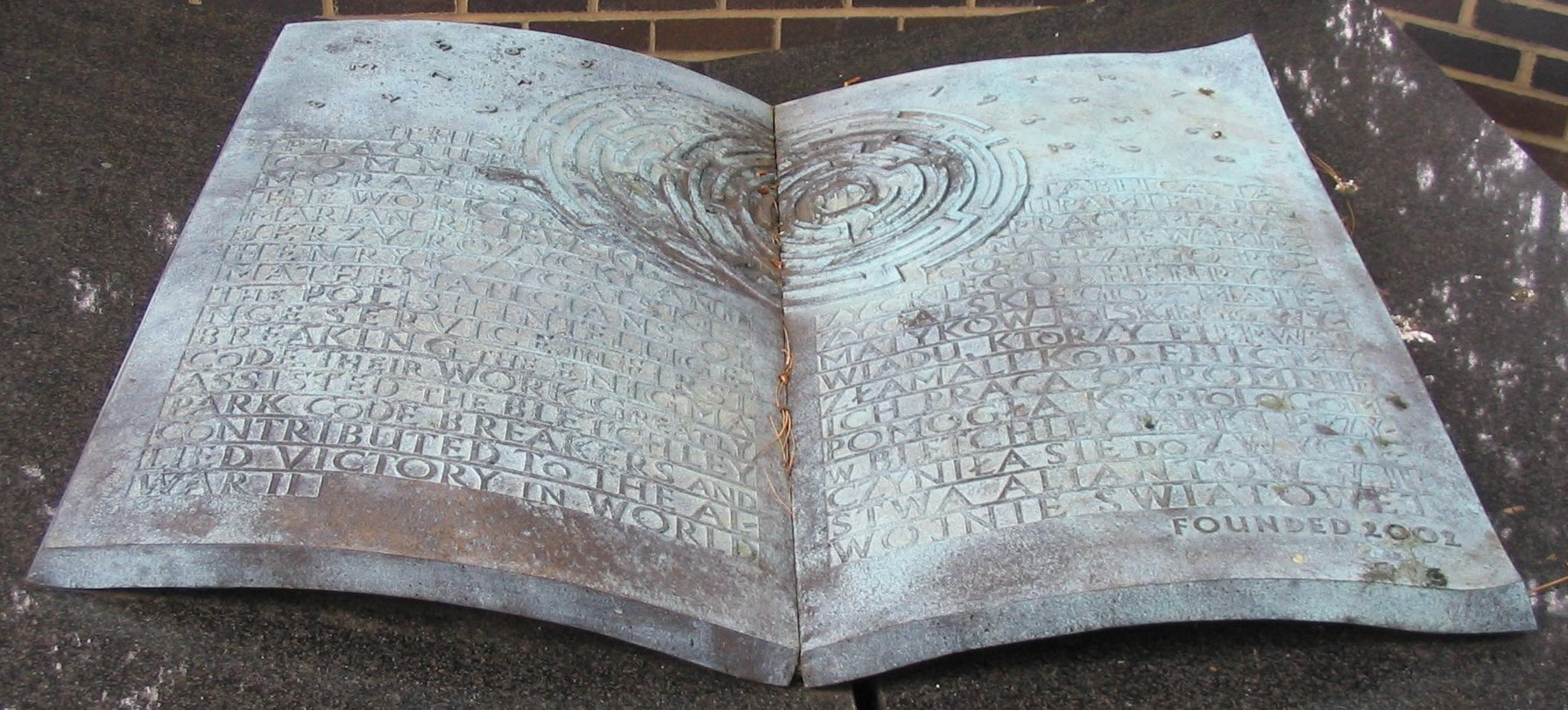
Initially, the German Enigma code was broken by Polish mathematicians, Marian Rejewski, Jerzy Różycki and Henryk Zygalski, working for Polish military intelligence. Just ahead of the invasion of Poland, bomba (mechanical codebreaking machine) were provided to the French and the British. This was the basis of the work during the war at Bletchley Park. Unfortunately, although the Poles had been first to break the code, they were deemed to be to high a security risk to work at Bletchley Park. 

Later, the same concept was applied and the British then built bombes for use at Bletchley Park. They were different in design than the Polish bomba, but, used the mathematical concepts developed by the Poles. The Polish contribution has been more recently acknowledged, as demonstrated by the plaque below.


CC BY-SA 2.0, https://commons.wikimedia.org/w/index.php?curid=460477

Discovering the secrets of others, through codebreaking or other means, has long been a major function of intelligence services.  Another approach has been the planting of false information. This has been used, not only to influence governments, but also to influence electorates.

In the 1980s, there was a Soviet disinformation campaign aimed at blaming the US government for developing the HIV/AIDS virus, and suggesting that it was to be a genocide of Black people (https://en.wikipedia.org/wiki/Operation_INFEKTION).  It had some effect, leading many to question what the origin of the virus was and led to further distrust of the American health care system.

More recently, there have been efforts at influencing public opinion regarding international events, such as the shooting down of a Malaysian jetliner over Ukraine. There have also been efforts at influencing election outcomes, presumably to get a result more favorable to the country which is interfering, whether in a referendum, such as Brexit, or election of political figures. (http://www.nytimes.com/2016/08/29/world/europe/russia-sweden-disinformation.html) This involves not only releasing factual information, but, making lies appear to be the truth. 

As someone who feels it is my duty to be an informed voter, it is increasingly difficult. There is no easy way to distinguish what is true and what is not. And, for many voters, there seems to be a trust in beliefs rather than facts. But, is this really unreasonable, when one can't trust "facts." So, it just seems easier to "trust" someone who seems "trustworthy" rather than attempt the seemingly Herculean task or sorting out what is true and what is not. To me, it seems most reasonable just to ask, "Who benefits?" and, "Do they have friends who would be able to construct a plausible reality?" To me, this is the greater concern, as authoritarian government is frightening to me, whether from the left or the right.


Tuesday, August 9, 2016

All Politics is Personal

August 9 is the anniversary of two important events. The first was the second use of nuclear weapons. Nagasaki. Coming three days after the first use.

My family was involved in the Manhattan Project. Many scientists and engineers were. But, after use of the bomb, many were plagued with a sense of responsibility. I discussed this more in my posts about President Obama's visit to Hiroshima. 

The second anniversary is that of the resignation of a President. Watergate. Adding "gate" to various other words has since come to suggest scandal. But, let's look back. The first election I voted in was 1972. The year of Watergate.

The Watergate scandal began when the DNC headquarters was broken into on June 17, 1972 (https://en.wikipedia.org/wiki/Watergate_scandal). It was in an office complex named Watergate, hence the name of the scandal. Investigation of the perpetrators lead to the Committee for the Reelection of the President, the aptly named CREEP. The ensuing scandal led to the resignation of the President Richard Nixon late on August 8, 1974, as the Watergate investigation led to Nixon's close aides. Gerald Ford then became President.But, first, Nixon tried to block the investigation by asking that the Special Investigator be fired. The Attorney General and a Deputy Attorney General both resigned, rather than comply, in what was called the Saturday Night Massacre on October 20, 1973. The Solicitor General then fired the Special Investigator at Nixon's bidding. Yet, Nixon could not stop the investigation.

I did not know of the resignation until August 9.  At the time, I was studying in Poland. A popular joke there, at the time, was that of an American, a Frenchman, and a Russian drinking together. The Frenchman commented that the best evening of his life was the evening spent with Brigitte Bardot (a popular French actress of the time). The American then said that the best evening of his life was an evening spent with the President. At this, all the Americans started laughing. And the Poles told us we hadn't heard the punchline. They then told us that the Russian then said that the best evening of his life was when two men came to his door and asked, "Are you Ivan Ivanovich?" He told his friends that he had said, "No." And then, he said, they left. That was the punchline. And, this joke, like so many others, expressed the truth that the Poles knew.

Years later, I interviewed a young woman, who was growing up in Washington at the time of Watergate. It was very interesting to hear the story told from the perspective of someone who had witnessed some of the events as a child. And, how those events impacted her and influenced her politics and choice of career.

The differences in reaction to the joke exposes the difference between the Americans who were, at the time, embarrassed by the Nixon and the events that led to his resignation. The Poles, on the other hand, had experienced the nighttime visits, and the visitors who didn't leave, but rather escorted the occupant out. My grandfather's second wife was given 15 minutes to pack for her family. Only two of them survived their two years in Siberia. None ever returned to their home in the Kresy, but rather had to wander for a while before finally making a home in the United States.

Tip O'Neill said, "All politics is local." But, I would suggest that it is personal. Each of us begins with the attitudes shared by our families. They have been shaped by their experiences. And, then, our personal experiences modify our political beliefs further.